
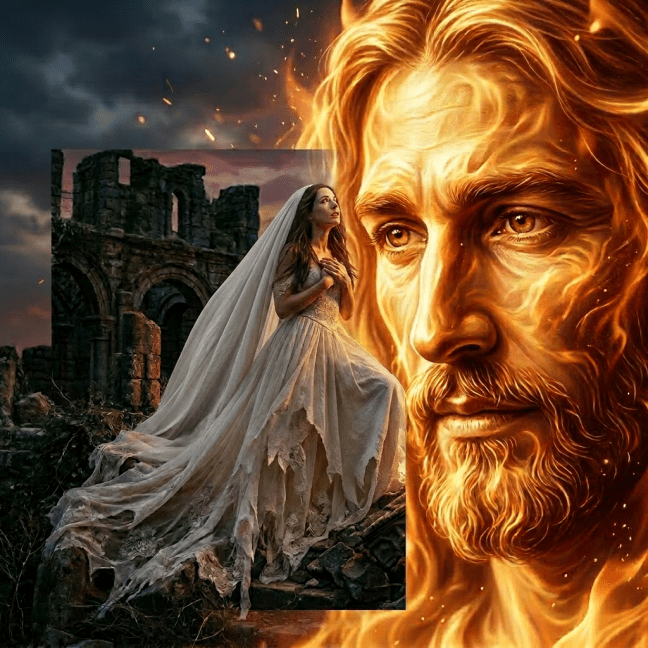
A Musical Adaptation of the Canonical Bridal Song
Divine Whispers | Viju Jeremiah Traven
Bride: I shattered the glass to reach for His scars; my tomb is an altar, my winter is past. His Flame is my life, and He holds me at last.
PRODUCTION NOTES
CHRIST’S THEATRICAL PRESENCE: Voice from above and behind a scrim — silhouette only. Hands visible in a spotlight in Scenes 5 and 5B. His face is never shown. His presence is felt through sound, light, and the Bride’s response. When He sings, His voice comes from everywhere and nowhere simultaneously.
THE COMPANY: The communion of saints. They surround the altar. They name what the Bride carries before she can name it herself. They carry the idol’s voice briefly in Scene 3 — one register shift, clearly marked — and resolve back to witness register immediately. They withdraw completely in Scene 6 and return for the finale. In the reprise they follow the Bride’s lead.
THE ALTAR: Present in every scene. The coal invisible in Act One. First visible in Scene 4 as a dim glow. Brighter through Scene 5. Fully burning in the reprise. The altar is not a prop. It is the governing symbol made physical. Its temperature tells the audience where they are in the arc.
THE THREE SILENCES: Non-negotiable. Not rests. Silences.
(1) Four beats — between the Pre-Chorus’s final word and Plain Line 1. Conductor measures it.
(2) Eight beats — Scene 6 close, after the ellipsis. Nothing fills it.
(3) Eight beats — after GL3 in the Coda. The silence is the new creation arriving.
TEMPORAL ANCHOR: The hour before dawn after a long cold night. The priest arriving at the altar when the fire should have died. The coal still breathing.
SCORE TEMPERATURE MAP:
Scenes 1–2 · Cold blue · D minor · pp→mp · Piano, soft strings
Scene 3 · Cold, pressing · F minor · mf→f · Sparse, staccato
[4-beat silence]
Chorus · Fire · D minor→F major · f→ff · Full orchestra
Scene 4 · Warm Red · F major · mp→mf · Cellos and choir
Scene 5 · Deep Red · D minor · mf→f · Cellos, low strings
Scene 5B · Warm Gold · F major · p→mp · Piano alone — Bride’s solo
Scene 6 · Warm Gold · F major · p→mp · Piano alone — Duet
Scene 7/Coda · Gold→Burning · F major→D major · mp→ppp · Piano→full orchestra
Reprise · Burning Gold · D major · ff→ppp · Full orchestra
Curtain · Unresolved · — · ppp · One sustained string
BRIDE’S VOICE FACE: The Surrendering (Attitude 14) — warm gold, releasing, begins constricted, opens progressively. Entry: narrow range, no ornamentation, melody barely above speaking pitch. Full resonance only in the reprise. Physical arc: standing still (Acts One and Two until 5B) → moves toward altar (Scene 4) → kneels (Scene 6) → rises (Scene 5B, then reprised in Coda) → both hands open (Coda).
ACT STRUCTURE AND INTERMISSION: Single intermission after Song 4 (The Governing Motif — Act One Chorus). Acts Two and Three run continuously without a second curtain. The momentum between Scene 5B (The Bride’s Naming) and Scene 6 (The Withheld Name Duet) must not be broken — these two scenes are one movement of the soul: her naming, then His recognition. A curtain between them would destroy the theology. Run time: Act One approximately 25–30 minutes. Acts Two and Three combined approximately 30–40 minutes. Total: 55–70 minutes.
ECHO ARCH:
Opening line: “I kissed the ember on your lips”
Closing line: “My Love’s the Flame that keeps you Mine”
The ember became the Flame. The kiss became the covenant.
ACT ONE — WOUND AND WITNESS
SCENE 1 — THE GIFT AND THE DEPARTURE
One emotional truth: He gave her everything. She let it cool without knowing it was cooling.
The stage is dark. The altar is cold. The Bride stands before it, hands at her sides. She does not know the audience is watching. She does not know the Bridegroom is watching.
From above — barely audible — the governing motif. A single note. Then two. The Bride does not hear it.
The Bridegroom’s voice — from behind the scrim, barely above the silence. The Incarnation Memory Solo:
SONG 1 — THE EMBER SOLO
Bridegroom · Solo · Single piano · pp→mp · D minor
[The Incarnation Memory — He sings from inside the flesh He chose, the breath He breathed, the altar He now touches cold]
THE BRIDEGROOM:
I kissed the ember on your lips,
I breathed My Spirit into flame;
before the world had learned to grieve,
Before it ever bore a name.
I touch the altar, cold with loss,
where once My glory blazed and shone;
the lampstand gutters, hollow-dark —
I kept the watch; you let it burn to stone.
( Jeremiah 1:5; Ephesians 1:4; Acts 2:3 · 1 Samuel 4:21; Exodus 40:34.)
[The music stops. Four beats of silence.]
PLAIN LINE 1 — ACT ONE:
THE BRIDEGROOM: (spoken, from above, barely audible) My Bride, where have you gone?
[Eight beats of silence. The Bride looks up. She does not know where the voice came from. The Company enters — not dramatically, but as witnesses arriving — surrounding the altar. They do not look at her. They look at what she is carrying.]
THE COMPANY: (spoken, quietly — naming what she carries before she can name it herself)
The cold has been in her chest longer than tonight.
She did not leave. She stayed.
But staying is not the same as burning.
And she has not burned in a long time.
[The orchestra enters beneath their testimony — low strings, minor key, D minor.]
SONG 2 — BREATH BY BREATH
Company · mp→mf · D minor · Moving strings
[The Company as witnesses — not accusers. They face the audience, not the Bride, when speaking in third person. They have been here. They know this.]
THE COMPANY:
Not in one thunder did it die,
but breath by breath, unseen;
the form of godliness remained
while the power slipped between.
She sang her songs with skillful tongue
yet would not seek His face;
a borrowed robe of outward things
laid cold upon His altar’s place.
(Ezekiel 10:18–19; 1 Samuel 4:21 · 2 Timothy 3:5; Isaiah 29:13 · Amos 5:21–23; Hosea 6:6 · Isaiah 64:6; 1 Samuel 4:21)
[The Company circles the altar. The Bride stands still. She knows this is true. She cannot say when it happened.]
SCENE 2 — WHAT WAS DONE WITH IT
One emotional truth: The institution replaced the fire with procedure. The Body bled in silence.
[The Company’s register shifts. Their voices drop. The orchestration turns cold — sparse, staccato, almost clinical. F minor. The idol’s voice is about to speak. It will sound exactly like faithfulness.]
THE COMPANY: (in the idol’s register — persuasive, almost reasonable, minor key)
Hold the line. Keep the form.
If you release it everything falls.
This is faithfulness. This is what staying looks like.
Hold on.
[The Bride’s hands tighten. She almost believes it. Then — the Bridegroom’s voice cuts through. The idol’s register falls away from the Company instantly. They return to their witness register.]
THE BRIDEGROOM: (spoken — three declarations, no music) Let every other voice stop.
I am the God of this altar.
I was here before it had a name.
SONG 3 — ICHABOD
Company · Cantor leads · mf building · F minor → cutting to silence
[The Company now in witness register — naming what happened without accusation. They are not condemning the Bride. They are naming what was done to the Body she belongs to.]
THE COMPANY:
You crowned control and called it wise
and buried grace before His eyes;
Ichabod — He cries it now: His glory has departed,
and He has watched His Body left brokenhearted.
He watched His Body bleed in silence, year on year;
the gifts He gave lay buried under fear;
what you called disloyalty was light,
what you nailed as order was the blight.
(Proverbs 12:15; Isaiah 5:21 · Matthew 23:23; Galatians 5:4 · 1 Samuel 4:21; Ezekiel 10:18 · Isaiah 61:1; 1 Corinthians 12:26 · Galatians 5:15 · Ephesians 4:11–13; 1 Kings 19:18 · Proverbs 27:6; John 3:20–21 · Luke 11:52; 2 Timothy 4:4)
[The music cuts. Four full beats of silence. Do not fill this. The Bride stands in it. The Company stands in it. The audience sits in it. The weight of it must land before the fire speaks.]
SCENE 3 — THE ACT ONE CHORUS
One emotional truth: The fire is still possible. The Bridegroom does not accuse. He invites. Daily death is how you rise.
[The orchestra enters — full, sovereign. The temperature shifts from cold confrontation to burning invitation. D minor → F major.]
SONG 4 — THE GOVERNING MOTIF (FIRST STATEMENT)
Company + Bridegroom · Full orchestra · f→ff · D minor → F major
[The Act One finale. GL2 sung over the Bride as she stands at the cold altar. The Company sings what she cannot yet sing. She receives it.]
THE COMPANY:
Those who will not burn will never learn,
to die each day and rise — and yearn;
Catch the Fire, My Bride, re-catch the Fire,
return — I’ll meet you and lift you higher.
I died to kiss the Bride at the Wedding of the Lamb Who reigns;
My Cross proclaims you are Mine —
My Blood declares My love divine;
My Love’s the Flame that keeps you Mine.
(2 Timothy 3:5; Colossians 1:27 · Luke 9:23; Romans 6:4; Song of Solomon 8:6 · Leviticus 6:12–13; Zephaniah 3:17; Isaiah 40:31 · Song of Songs 1:2; Revelation 19:7 · Galatians 2:20; 1 Corinthians 6:20 · Hebrews 12:24; Romans 5:8 · Song of Solomon 8:6; John 10:28; Numbers 6:24.)
[The Bride stands at the altar. Both hands still at her sides. She has heard it. She has not moved yet.]
[One sustained string — unresolved. The lights fade on Act One.]
CURTAIN — ACT ONE
ACT TWO — CROSS AND CROSSING
SCENE 4 — THE COAL THAT DID NOT DIE
One emotional truth: He never stopped tending it. The mercy preceded the return.
[The stage is the same cold altar. But now — above it — the Bridegroom’s hands are visible in a single spotlight. Not His face. His hands. They are bending over the altar — over the grey ash — and breathing. The Bride sees the hands before she hears the voice. She moves toward the altar for the first time.]
[The Company enters quietly — witnesses, not participants. They carry the remnant testimony. They have been where the Bride is going.]
PLAIN LINE 2 — ACT TWO:
THE BRIDEGROOM: (spoken, barely audible, above the altar) I bent and breathed above the grey.
[A single cello note beneath the silence. The dim glow of the coal becomes visible for the first time. Then the Bridegroom sings — the same hands visible, bending.]
SONG 5 — THE COAL NEVER COLD
Bridegroom + Company · Cellos and choir · mp→mf · F major
[Warm Red temperature — the most expensive sound in the score. The Company here are not observers of someone else’s suffering. They are people who came through a winter they did not know would end — and did not know they would be standing here to say so. Stage them as if each one is surprised to be alive. Not triumphant. Surprised. The mercy they are declaring is mercy they did not expect to receive. Their posture: they have been somewhere dark and returned. Their eyes carry what the Bride’s eyes will carry in thirty minutes. They are singing her future back to her from inside it.]
THE BRIDEGROOM: But the coal was never fully cold,
I bent and breathed above the grey.
My mercy kept the remnant in My hold,
new every morning, every day.
They would not kneel where chill had come to quench the altar’s fire,
nor trade the Cross for softer beds or all the world’s desire;
their scars became the holy ground where I have pressed My claim,
the brandmark of the wounded Lamb, their bodies kept aflame.
THE COMPANY: (testimony — they have been here)
Unquenchable, the love endured the storm, the fire, the flood;
no torrent drowned the seal of God once sealed within the blood.
Their wounds became the altars where the oil of mercy poured,
through every winter, tried and proved, discerned, and not ignored.
Cold endured becomes the gold the Refiner’s fire reclaims;
no flood can quench, no river drown, the Spirit’s living flames;
this is no ember of a season, fading where it lay,
this is the Holy invasion’s heat that will not pass away.
(Isaiah 1:9; 1 Kings 19:18 · Romans 11:5; Lamentations 3:22 · Lamentations 3:22–23; Exodus 16:21 · Romans 11:4; 1 Kings 19:18 · Philippians 3:10; Hebrews 12:2 · Galatians 6:17; Romans 12:1–2 · Isaiah 43:2; Song of Solomon 8:7 · Ephesians 1:13; Romans 12:11 · Zechariah 13:9; Job 23:10 · 1 Peter 1:7; Job 23:10 · John 10:28–29; Romans 8:38–39 · Acts 1:8; Hebrews 12:29.)
[The Bride looks at the altar. She can see the coal. It is still breathing.]
SCENE 5 — GETHSEMANE AND THE TORN EMBRACE
One emotional truth: The Cross was not duty. It was love that chose to bear the cost.
[The Company withdraws to the edges of the stage. The lighting shifts — low, red, the shadow of Gethsemane. The Bridegroom’s silhouette visible behind the scrim — kneeling. This is the slowest scene in the production. The most expensive sound in the score. The audience must feel what it cost before they receive what it purchased.]
SONG 6 — THE TORN EMBRACE
Bridegroom · Through-composed couplets · Cellos, low strings · mf→f · D minor
[At the Bridge’s close: the Bridegroom’s hands come forward through the scrim into the light. The nail-marks are visible. The Close-Up Law honored: the vast contracted to one specific physical detail at full theatrical weight. The Bride reaches toward the hands. She does not touch them yet.]
THE BRIDEGROOM: I am jealous, not as proud rulers burn,
but as love that knelt in Gethsemane and would not turn;
every lesser love, when tested, unveils its own blame,
I stood where love costs all, chose yours, and bore the flame.
My Blood was not shed for your striving, fervor, or your strife,
I poured it all to make you Mine, to give you My endless life.
I paid the penalty for sin and drew you into grace;
not by your hands or altar-fire, but by My torn embrace.
I bled to name you Bride, not slave, redeemed by covenant love,
that you might dance before My eyes and mirror Heaven above.
(2 Corinthians 11:2; Exodus 34:14 · Matthew 26:36–46; John 13:1 · Isaiah 53:4–5; Galatians 2:20 · Hosea 6:6; Micah 6:6–8 · 1 Peter 1:18–19; John 10:10 · Ephesians 2:13; Song of Songs 2:16 · Hosea 6:6; Psalm 51:16–17 · John 15:15; 1 Corinthians 6:20 · John 17:24; Song of Songs 1:15)
[The hands remain visible through the scrim. The orchestra holds. One note. Unresolved. The Bride looks at His hands. Then at her own.]
SCENE 5B — THE BRIDE’S NAMING
One emotional truth: She names the full cost of what she has been holding. In her own voice. Before He speaks to her.
[The Company withdraws further — to the very edges, barely visible. The Bridegroom’s hands are still. The piano enters, single line. The Bride stands alone at the altar. She sings for the first time. Her voice begins narrow — constricted — and opens as she releases.]
SONG 7 — I RISE AND LAY MY WINTER DOWN
The Bride · Piano alone · p→mp · 3/4 time · F major
[The Surrendering Bride — her voice begins constricted and opens line by line as she names and releases. No ornamentation. The melody barely above speaking pitch. The composer must resist the impulse to swell beneath her. Let her voice carry the weight alone until the final quatrain.]
THE BRIDE: I rise and lay my winter down;
I come not clothed in pride,
with open, trembling, empty hands:
make me Your burning, radiant Bride.
Lord, rekindle what I quenched in fear;
let every scar be turned to gold;
Your altar-stone, Your dwelling place,
O burn me spotless, warm the cold.
[Strings enter softly beneath the second quatrain — barely there, a warmth beneath her voice:]
Worthy are You; I bow, the Bride
who reigns at Your behest;
no longer driven by my care,
but resting on Your breast.
Behold, I make myself now ready;
I come without delay,
the Bride who hears will not be found
a moment turned away.
( Isaiah 60:1; Song of Songs 2:11 · Philippians 3:9; Isaiah 64:6 · Ephesians 5:27; Revelation 19:7–8 · 2 Timothy 1:6–7; 1 Thessalonians 5:19 · 2 Corinthians 12:9; Malachi 3:2–3 · 1 Corinthians 3:16 · Revelation 4:11; Song of Songs 2:10 · John 13:23; Luke 10:40–42 · Revelation 19:7; Matthew 25:10 · Revelation 22:17; Matthew 25:1–10 · John 10:27; Song of Songs 3:4.)
[She opens one hand. Just one. The piano holds. The strings fade. Silence.]
[She has named the cost. Now He can name what He sees.]
SCENE 6 — THE WITHHELD NAME DUET
One emotional truth: He sees her specifically. Not the Bride in general. This woman. This wound. This night.
[The Company withdraws entirely — they leave in silence, without a number, between one breath and the next. The stage empties. The orchestra reduces to piano, single line. The spotlight narrows to the Bride and the Bridegroom’s hands still visible at the scrim. The audience watches from outside an intimacy that was not staged for them. That exclusion is the point.]
THE BRIDEGROOM: (spoken — the Withheld Name, no music)
I see you.
I have always seen you.
[Beat. The longest beat in the production.]
THE BRIDEGROOM: (spoken) You stayed.
[She cannot speak. He does not rush. What follows is not comfort offered from a distance. It is recognition spoken from inside the scene.]
THE BRIDEGROOM: (spoken, then moving into song as the piano enters beneath) Every hour of this coldness — I have been watching.
Not the failure. The faithfulness inside the failure.
Not the cold. The staying when the fire ran out
and there was nothing left to tend with
except the will to tend.
SONG 8 — COME OVER, MY BELOVED
Bridegroom · Piano alone · p→mp · F major
[One instrument. The Bridegroom to this Bride specifically. The audience overhears. The Hero’s Treasure named: not the strength — the staying.]
THE BRIDEGROOM: Arise, My love, and come away,
the long cold winter now is past;
I stand and watch with eyes of flame
and call you, truly, home at last.
Return to Me; the altar waits;
I keep no debt and hold no score;
and each step home you turn toward Me,
I run to meet you all the more.
I did not build you for the ruin;
I built you for My name.
The Bride I seek shall not be found
weeping before a cold, spent flame.
She rises from the ruin burning,
her garments white with love,
not white with innocence alone,
but sealed and signed by grace above.
(Song of Songs 2:10; Isaiah 52:1 · Song of Songs 2:11; Isaiah 44:22 · Revelation 1:14; Revelation 3:20 · Isaiah 43:1; John 10:3 · Joel 2:12; Malachi 3:7 · Romans 4:8; 2 Corinthians 5:19 · Luke 15:20; Zephaniah 3:17 · Jeremiah 29:11; 1 Thessalonians 5:9 · Isaiah 43:7; Ephesians 2:10 · Revelation 19:7; Matthew 25:10 · Revelation 2:4–5; Matthew 25:8 · Isaiah 60:1; Revelation 19:7 · Revelation 19:8; Revelation 7:14 · Ephesians 1:13–14; 2 Corinthians 1:22.)
[He places the light over her hands — or rather: the light from above narrows to cover both her hands and the hands still visible through the scrim. The audience cannot see whether He is touching her. They feel that He is.]
THE BRIDEGROOM: (spoken — the Holy Incompletion) I did not build you for the ruin.
I built you for My name.
Come up from the cold.
I have the altar.
I have always had the altar.
You were never tending this fire alone…
[Eight beats of silence. The ellipsis is not a pause. It is an open sentence. Do not resolve it. The piano holds one unresolved note.]
[The Bride looks at His hands. Then at her own. Then she opens both hands. The rope falls.]
THE BRIDE: (spoken, barely audible) You have the altar.
You have always had the altar.
I was never tending this fire alone.
[The piano resolves. One note. Then silence again.]
CURTAIN — ACT TWO
ACT THREE — UNION AND SENDING
SCENE 7 — THE CODA AND THE SENDING
One emotional truth: She returns the fire to the One who gave it. The fire is His — and it is what keeps her His.
[Light begins to change. The Company returns — quietly, surrounding the altar, witnesses to what has happened. They do not sing yet. They watch. The coal on the altar is glowing fully now — the first full light in the production.]
[The Bride faces forward. Both hands open.]
THE CODA — SPOKEN INTO SILENCE
The Bride · Voice alone · No accompaniment
THE BRIDE: Come, Lord Yeshua, seal what You have purchased,
come and take my cold away.
The Spirit and the Bride say: Come, Lord, come.
(Revelation 22:20; 1 Corinthians 6:20 · Song of Songs 2:11; Joel 2:12 · Revelation 22:17.)
[Silence. Eight full beats. The conductor’s hands are still. Nothing moves. The Spirit inhabits this silence. Do not fill it.]
[Then — spoken, not sung, bare, no orchestra:]
PLAIN LINE 3 — ACT THREE (GL3):
THE BRIDE: (spoken — then the full orchestra enters on the final word) My Love’s the Flame that keeps you Mine.
[On MINE — the full orchestra enters. The governing motif begins. The Company sings. The Bride leads for the first time.]
SONG 9 — THE REPRISE (THE GOVERNING MOTIF AT FULL DEPTH)
Company + Bride · Full orchestra · ff→ppp · D major
[The first time the Bride leads. The Company follows her. The audience hears what they heard at the opening of Act One. They know now what it cost.]
COMPANY + BRIDE: Those who will not burn will never learn,
to die each day and rise — and yearn;
Catch the Fire, My Bride, re-catch the Fire,
return — I’ll meet you and lift you higher.
I died to kiss the Bride at the Wedding of the Lamb Who reigns;
My Cross proclaims you are Mine —
My Blood declares My love divine;
My Love’s the Flame that keeps you Mine.
(2 Timothy 3:5; Colossians 1:27 · Luke 9:23; Romans 6:4; Song of Solomon 8:6 · Leviticus 6:12–13; Zephaniah 3:17; Isaiah 40:31 · Song of Songs 1:2; Revelation 19:7 · Galatians 2:20; 1 Corinthians 6:20 · Hebrews 12:24; Romans 5:8 · Song of Solomon 8:6; John 10:28; Numbers 6:24.)
[The orchestra builds to ff — then, on the final word MINE — cuts to ppp. One sustained string. The governing motif plays one final phrase and stops before its cadence completes.]
[THE UNRESOLVED CURTAIN: The lights fade on the Bride with both hands open — the coal burning on the altar, the fire alive, the earth not yet all fire, the mission not yet complete. The audience leaves with one note still sounding. They return not from duty. From thirst.]
CURTAIN.
I died to kiss the Bride at the Wedding of the Lamb Who reigns; My Love’s the Flame that keeps you Mine.
(Song of Songs 1:2; Revelation 19:7; Song of Solomon 8:6; John 10:28; Numbers 6:24).
APPLICATION & PRAYER
Application: Lay your ministry credentials on the floor in total surrender. Act today in a way that offers no earthly benefit, only a heavenly fragrance.
Prayer: Judge of all, purge my temple. If I have built a kingdom of clay, let the fire fall until only gold remains. Make me a grain of wheat that dies to the world so Your Life might sprout in those You have entrusted to me. Amen.
SONG LIST
1 — THE EMBER SOLO · Bridegroom · Act One Scene 1
2 — BREATH BY BREATH · Company · Act One Scene 1
3 — ICHABOD · Company · Act One Scene 2
4 — THE GOVERNING MOTIF (FIRST STATEMENT) · Company + Bridegroom · Act One Scene 3
5 — THE COAL NEVER COLD · Bridegroom + Company · Act Two Scene 4
6 — THE TORN EMBRACE · Bridegroom · Act Two Scene 5
7 — I RISE AND LAY MY WINTER DOWN · The Bride · Act Two Scene 5B
8 — COME OVER, MY BELOVED · Bridegroom · Act Two Scene 6
9 — THE REPRISE · Company + Bride · Act Three
 vjtravenblog