
Divine Whispers | Viju Jeremiah Traven
Bride: The jar I kept in the dark was never wasted. It was always the act of worship.
Beloved,
Before the music forms, before the breath rises, before worship finds its voice, I have already heard the cry your heart cannot contain (Psalm 139:1–2). My name is a poured perfume: before you knew Me, My love flew to you (Song of Songs 1:3; 2 Corinthians 2:14–16; Jeremiah 31:3).
Four women. Four settings. One alabaster jar, one fragrance representing the Bride of Christ and her act of worship (Matthew 26:6–13; Mark 14:3–9; Luke 7:36–50; John 12:1–8). They are not women in ancient ink. They are the four faces of your one heart of worship, reflecting the heart of God.
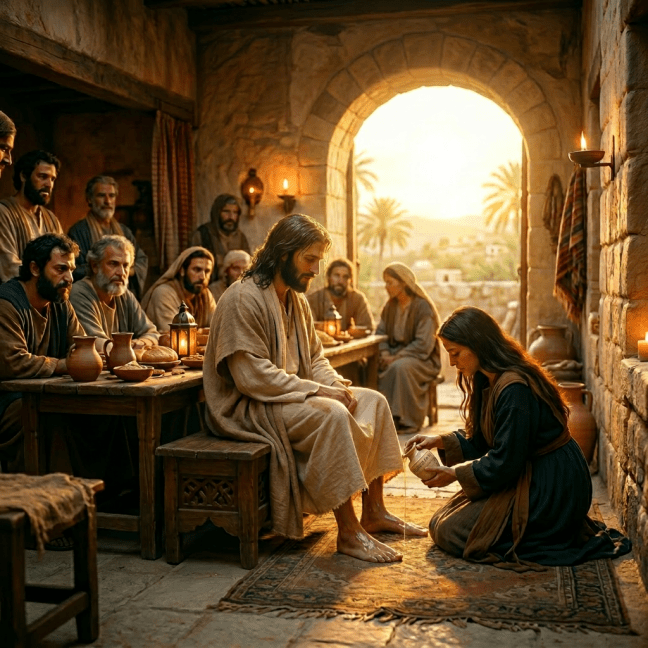
I. She Washed His Feet With What She Could Not Say
The room smelled of hot food and cold judgment. Simon had invited Me. His heart had not. He knew the Scriptures. He did not know their power (John 5:39).
You brought the jar, and a sinful past, and its guilt in your chest. Your worship rose before Me as a living flame, and I received it: a heart made new (Romans 12:1–2).
But your knees found My feet before your lips could form My name. You came in sacred silence, spirit and soul and body bowed (1 Thessalonians 5:23). What love cannot utter, it breaks; what it breaks, He fills with His name. You washed My feet with what was breaking inside you, and dried them with your own hair, the thing a woman in that age guarded as her glory, laid down at My feet (Luke 7:38).
I felt the weight of what you carried in. The years of it. The room you had locked inside yourself, where the shame lived and would not leave. You brought it to this house with the only thing you had left. I did not look away. I have never looked away from what you brought Me in the dark.
Simon called it waste (Luke 7:39). The Pharisees kept a tight ledger of your failures. I nailed that ledger to the Cross and set you free (Colossians 2:14). And in that room, before the watching faces, I spoke what shame had tried to bury: her love was great, and everything she owed has been forgiven (Luke 7:47).
Your first fragrance was not perfume. It was a heart that finally stopped hiding.
(Psalm 51:17)
II. What They Called Waste, I Called Mine
Before the dawn, before the bloom, I was within this room; and caught your heart and held its spark, as alabaster found its mark.
She came unnamed into a room in Bethany. She shattered the alabaster, and the spikenard was poured, and those who watched in silence called it waste (Mark 14:3–9). I had known the jar, and the hand that held it, before the jar was broken. What she poured in love, I received: let it be known until the end of the world (Matthew 26:13; Mark 14:9). While the house stood watching, she let the fragrance fall. This is worship: when the jar breaks and gives its all.
I have always known her. My Father drew her (John 6:44). I claimed her (John 10:28–29). When what you counted as gain is poured away, what remains is the worth no treasure could weigh (Philippians 3:7–8).
Those who serve the silver, the seat, the reach: they disown Me (Matthew 6:24; Luke 9:26). What they have named worthless, I call Mine. The stone they cast aside is the one I build on (Psalm 118:22; 1 Peter 2:4–7). That stone is you (1 Peter 2:5).
Throughout every age I have used what was shattered to display what is unbreakable: the shattered pitchers of Gideon in the dark (Judges 7:19–20), the broken heart of David with nothing left to offer but the fracture itself (Psalm 51:17), the poured-out life of Paul, emptied to the last drop and rejoicing in Me to the very end (Philippians 2:17; 2 Timothy 4:6).
Without consecration you will not see My face, and holiness is always a winepress. When the road you walked in love has left you undone, I correct the ones I love (Hebrews 12:6; Proverbs 3:12). The good work begun in you, I will finish (Philippians 1:6).
What you have read as distance is the proof that I am near. The branch that endures consecration is the branch the Father prunes with care (John 15:1–2).
So when you are mocked, dishonoured, rejected for what love required of you, remember that I trod this winepress alone to bring you near (Isaiah 63:3) and purchase you with My Blood (1 Peter 1:18–19). What it presses out of you is what I have always called your best. Rejoice: the winepress was never built to oppress what it was sent to consecrate and bless (Romans 5:3–4; 1 Peter 4:13).
III. She Crowned Him Before the Thorns Did
Beloved, you crowned My head before the world placed its thorns, but yours remains forever.
I remember the cold of the garden ground beneath My knees, the earth I made, pressing back against Me (Luke 22:39–44; Matthew 26:36–46). The weight I felt was not the night air. It rose from inside My chest: the full cost of what I was about to choose. I knelt in the dark of that garden. I chose. I rose, and I carried you.
Your hands had already crowned Me with the fragrance of your heart before the hands of men pressed thorns into My head (Matthew 27:29).
What the apostle later sealed in ink, your tears had already proven: He became poor with everything He had, so that through His poverty you might be made rich (2 Corinthians 8:9). You emptied what you held and trusted Me to fill what you could not hold inside. With tears you sowed the whole of what you carried into My sufferings, for souls (Philippians 3:10; Psalm 126:5).
What you displayed in that room was not knowledge learned from men: My Father had shown it to you (Matthew 16:17). Your worship was pure prophecy. When you poured the oil over My head, you were not performing a religious act; you were making the declaration the prophets had always made over kings: set apart, chosen, sent (Exodus 29:7; 1 Samuel 16:13). Through your worship you proved who you are: the Bride preparing for the Wedding of the Lamb (Revelation 19:7).
You crowned My head before the world crowned Me with scorn; your fragrance was hidden to cover My wounds beneath the crown of thorns.
(Matthew 26:6–13; Matthew 27:29)
Roman soldiers pressed a reed into My hand, that hand, the one she had just anointed, and knelt to mock what they had never known (Mark 15:17–19). You had already honoured the King of kings, Whose Cross would be His throne (Revelation 5:12; Revelation 19:16).
IV. The Low Place Was the Only Place He Stood
One day the house was busy with work under Martha’s headship. But Mary of Bethany, you sat down at My feet to honour My Lordship (Luke 10:38–42).
Not because the work did not matter, but because I had come to give, not to receive (Mark 10:45). I watched you choose the low place at My feet, again and again. What you chose for communion, I preserved for eternal union (Luke 10:42).
You bought the perfume early. You kept it in the dark. And when the hour came, you revealed your spark.
You knew I would walk to the hill and hang upon the tree (John 19:17–18), descend into silence, and rise on the third morning (Luke 24:6–7). You knew I would return to My Father, be seated in glory, crowned with many crowns, and descend with the angels in the clouds to claim the flawless Bride I call My own (Hebrews 1:3; Matthew 24:30; Revelation 19:7; 19:12).
And knowing all of this, you stayed at My feet.
Therefore, you poured yourself upon Me and declared: wherever You are, there I shall be (Revelation 14:4). Like fragrance upon My skin, you chose to remain with Me, in seasons of sorrow and seasons of joy, in the Cross and in the crown, in the tomb and on the throne (Ephesians 2:6; Revelation 5:10).
What grew between us in the low place made you known, in a way no school could enter and no scholar could have shown (1 Corinthians 2:9–10).
V. The Perfume Formed in the Dark
What formed between us in the dark was stronger than anything the light could make.
What you carried into that room did not form in the open. It formed in the dark, between us, in the years before the hour came.
The spikenard did not become precious in the open. It became precious in the sealed jar, in the dark and the stillness, pressed and concentrated until its fragrance deepened into something no marketplace could imitate (John 12:3).
What ripened in the hidden became the offering you loved more than all you possessed.
Others sought My hand, but you desired My face.
(Psalm 27:8)
Before you knew you were loved, you were loved (Jeremiah 31:3; 1 John 4:10; 1 John 4:19). Before the jar existed, I knew its fragrance. I am not telling you something new. I am telling you what has always been true: what was true before you knew to call it worship.
And because you stayed with Me in the night, your fragrance learned the language of light.
When the jar broke, you were in that room. The fragrance sealed with My Body in the tomb (John 19:40).
Not four women, but one wonder. Not divided devotion, but love brought to completion. The tears that washed My feet before the perfume did, the quietness of the low place, the vessel broken to reveal its treasure, and the oil poured upon My head before I wore the thorns: these did not remain four stories separated by time. They melted together, as oil dissolves into oil and deep calls unto deep (Psalm 42:7). What seemed many streams became one river; what sounded like many voices became one song.
All rose before Me as one offering, like incense before My throne (Psalm 141:2; Revelation 8:3–4). You have become My only dove, My flawless delight (Song of Songs 6:9), clothed in white, without spot or wrinkle (Ephesians 5:27), for the Bride has made herself ready (Revelation 19:7–8). I see one offering, one fragrance, one glory, one Bride, beautiful and bright, wholly and forever Mine (Song of Songs 2:4).
VI. I Did Not Become Worthy of Him. I Became His.
The jar you kept in the dark was never waste. It was your intimate act of worship.
Your life has become one endless kiss of bliss upon My soul, a love made whole that time itself cannot control (Song of Songs 8:7).
You alone knew: the heart of worship is the heart of God.
(Song of Songs 1:2)
True worship is not measured by the songs upon your lips or the hands you lift toward heaven. It is found when you are consumed with love for the Lamb (Galatians 2:20), when the jar is shattered and nothing is kept back for a lesser day, when every hidden sorrow and secret fragrance you carried through the night are poured into the light, and the room you are in trembles with the beauty of what was formed in the dark (John 12:3).
Your highest reward is not the gold, however bright, but the Lamb before your eyes: your everlasting light (Revelation 21:21; 22:4–5).
It is that you shall follow Me wherever I go (Revelation 14:4), through the wounds and into the wonder, from the Cross to the crown, from the garden to the glory, until you and I dwell together in the morning that knows no evening and the day that knows no dying (Revelation 22:5). And when heaven and earth resound with one victorious refrain, the Lamb Who was slain shall forever reign (Revelation 5:12), and you, My spotless Bride, shall abide by My side, world without end, Amen (Revelation 22:3–5).
Open Bible
Open your Bible to John 12:7. Place your hand over the page. Say aloud: “She has kept this for the day of His burial.” Let those words find what is still sealed in you. Then ask: what have I been carrying through the dark that was always meant for His skin?
Prayer
Here is my alabaster jar: the prime years, the hidden hurts, the secret dreams, the unkept places. I shatter it at Your feet, withholding nothing. Let my fragrance follow You to the throne. I am Yours. You are Mine. Amen.
(Song of Songs 2:16)
The Bridegroom
What she poured in the dark, the room called waste.
What the room called waste, I received.
What I received, I have proclaimed to every age (Matthew 26:13; Mark 14:9).
Tell them the heart of all the worship of the earth
Is not the polished show the watching tribes call worth (John 12:3).
Tell them Simon’s clean theology, with no repentant tears,
Is nothing but a cold religion built to hide its fears (Luke 7:44–46).
They count the cost to save the box; she breaks the jar to kiss the Rock (Luke 7:47–50; Matthew 26:8–9).
Go tell them what the Bridegroom said before He met the iron nail:
What all the frantic room calls waste, He calls His own within the veil (Matthew 26:10–13; Mark 14:6–9).

